Blog
Tulsidas Jayanti 2026: Goswami Tulsidas Jayanti to Be Observed on August 19, Know the Life, Works and Legacy of the Ramcharitmanas Author

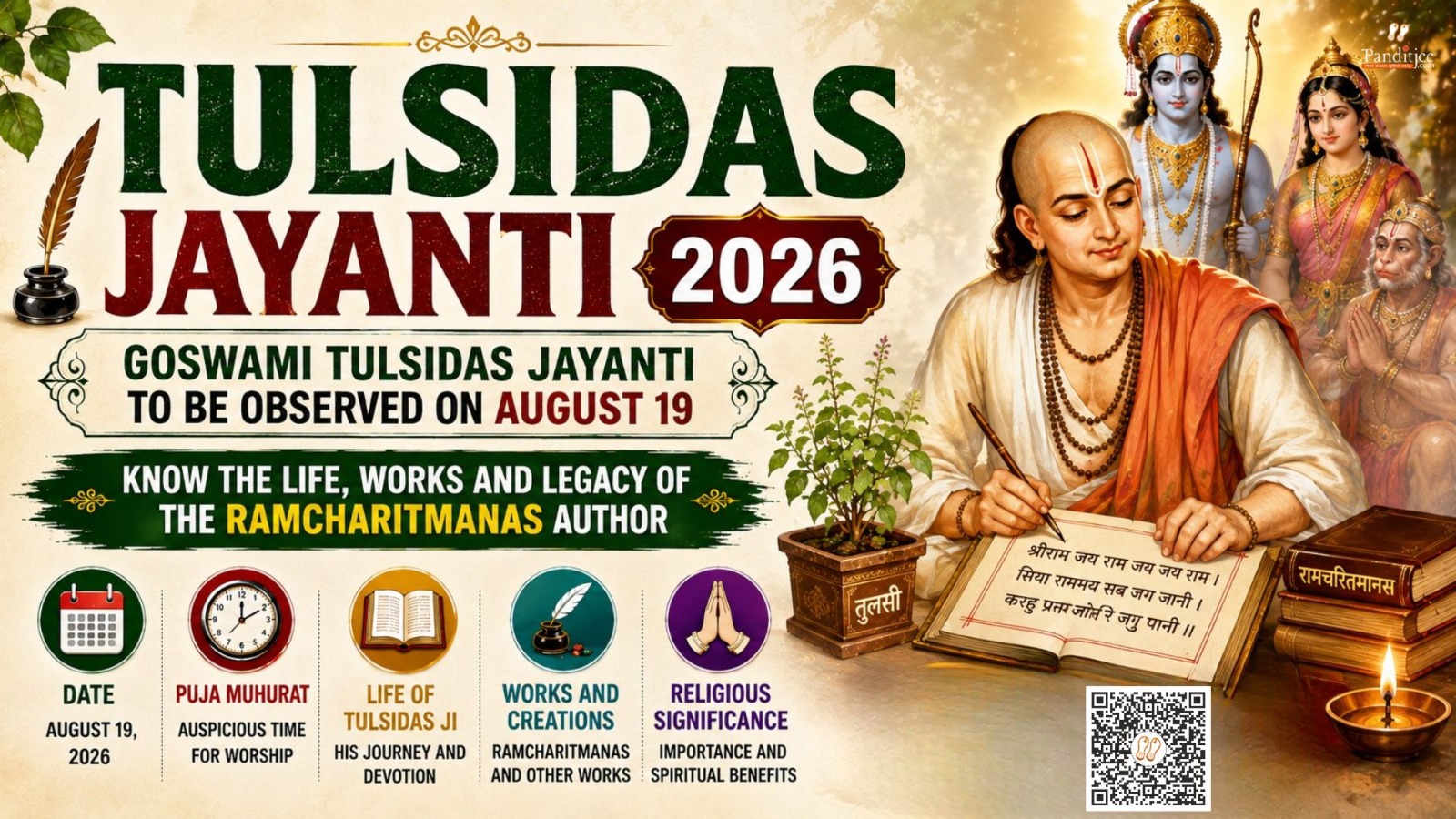
Goswami Tulsidas is regarded as one of the most influential saints, poets and spiritual thinkers of 16th-century India. His contribution to Indian devotional literature and the Bhakti tradition remains deeply significant. His most celebrated work, Ramcharitmanas, brought the story and ideals of Lord Rama closer to the common people through the Awadhi language.
Tulsidas was not only the author of Ramcharitmanas but also composed several other important works, including Dohavali, Kavitavali, Vinay Patrika, Krishna Gitavali, Parvati Mangal and Sahitya Ratna. He is also traditionally regarded as the composer of the Hanuman Chalisa, one of the most widely recited devotional compositions dedicated to Lord Hanuman.
Tulsidas Jayanti 2026 will be observed on Wednesday, August 19. The occasion is traditionally observed on the seventh day of the Krishna Paksha of the month of Shravan. Devotees mark the day by remembering Goswami Tulsidas, reciting verses from Ramcharitmanas, chanting Hanuman Chalisa and offering prayers to Lord Rama and Lord Hanuman.
Tulsidas Jayanti 2026 Date and Religious Significance
Tulsidas Jayanti is observed in honour of Goswami Tulsidas, the revered saint-poet whose writings played a major role in popularising Rama Bhakti among the masses.
In 2026, Tulsidas Jayanti will be observed on August 19, Wednesday. Devotees traditionally celebrate the occasion by worshipping Lord Rama and Lord Hanuman, reading Ramcharitmanas and reciting Hanuman Chalisa.
Religious institutions and temples may also organise Ram Katha, devotional singing, recitations, spiritual discourses and other programmes to remember the teachings and literary contribution of Tulsidas.
The day is significant not only from a religious perspective but also from a literary and cultural point of view. Tulsidas transformed the way devotional literature was communicated to ordinary people by expressing profound spiritual ideas in a language that was accessible to the wider society.
Who Was Goswami Tulsidas? Know His Life Story
Goswami Tulsidas is traditionally believed to have been born in Rajapur in the Chitrakoot region of present-day Uttar Pradesh. His early life is associated with several traditional accounts describing difficult circumstances surrounding his childhood.
According to popular tradition, Tulsidas faced hardship from an early age and was later brought up under the guidance of Narharidas. He is believed to have heard the story of Lord Rama during his childhood, which had a lasting influence on his spiritual life.
He initially studied in Ayodhya and later travelled to Varanasi, where he studied Sanskrit grammar, the Vedas, Vedangas, astrology and different schools of philosophy.
His deep devotion to Lord Rama eventually became the central theme of his spiritual and literary life. Tulsidas spent significant periods in important religious centres such as Ayodhya, Chitrakoot, Prayagraj and Varanasi, where he narrated the Ramayana and spread the message of devotion, righteousness and moral conduct.
Tulsidas and Ratnavali: The Turning Point in His Life
Tulsidas was married to Ratnavali, and traditional accounts describe his deep attachment to his wife during his early married life.
According to the popular story associated with his transformation, Ratnavali’s words made Tulsidas realise the depth of his attachment to worldly life. This experience is traditionally regarded as an important turning point that encouraged him to move away from worldly attachment and dedicate himself to devotion to Lord Rama.
After this transformation, Tulsidas devoted his life to spiritual practice, religious storytelling and literary composition. His writings reflect the profound influence of Rama Bhakti on his thoughts and worldview.
Although several details of his biography come from traditional and devotional accounts, Tulsidas remains one of the most important figures in the history of Indian devotional literature.
Ramcharitmanas: The Immortal Work of Tulsidas
The most famous work associated with Goswami Tulsidas is Ramcharitmanas. The ancient Sanskrit Ramayana of Maharishi Valmiki is one of the principal sources of the Rama narrative in Indian tradition. Tulsidas presented the story of Lord Rama in Awadhi, making it accessible to a much wider audience.
Ramcharitmanas is not simply a retelling of the Ramayana. Through its poetic presentation, Tulsidas emphasised devotion, righteousness, duty, compassion, truth and the ideals represented by Lord Rama.
The work played a significant role in making Rama’s story accessible to people who did not have knowledge of Sanskrit. Its verses, couplets and devotional passages continue to be recited in homes, temples, religious gatherings and cultural programmes.
For centuries, Ramcharitmanas has remained an important part of North India’s religious, cultural and literary traditions. Its influence can be seen in religious storytelling, folk traditions, devotional music and public celebrations associated with Lord Rama.
Major Literary Works of Goswami Tulsidas
Tulsidas made a lasting contribution to Indian devotional and Hindi literature through numerous works. His literary legacy extends far beyond Ramcharitmanas.
Some of his important works include Dohavali, Kavitavali, Vinay Patrika, Krishna Gitavali, Parvati Mangal and Sahitya Ratna.
These works explore devotion, spirituality, morality, religious values and human conduct. Tulsidas used poetry to communicate complex spiritual ideas in a form that could be understood and remembered by ordinary people.
His writing style combined devotion with powerful poetic expression, which helped his works remain relevant across generations.
Why Is Tulsidas Associated With Hanuman Chalisa?
Goswami Tulsidas is traditionally regarded as the composer of the Hanuman Chalisa, a devotional hymn dedicated to Lord Hanuman.
The Hanuman Chalisa describes the strength, wisdom, courage, humility and devotion of Lord Hanuman. It also highlights Hanuman’s unwavering devotion to Lord Rama.
The composition has become one of the most widely recited devotional texts in Hindu religious practice. Millions of devotees recite it regularly, particularly on Tuesdays, Saturdays and during religious occasions associated with Lord Hanuman.
Tulsidas’s devotion to both Lord Rama and Lord Hanuman is clearly reflected in his literary and spiritual tradition.
Tulsidas and His Connection With Varanasi
Varanasi occupies an important place in the traditional accounts of Tulsidas’s life. The famous Tulsi Ghat in Varanasi is named in his honour and remains associated with his literary and devotional legacy.
The Sankat Mochan Temple in Varanasi is also traditionally connected with Tulsidas. The temple is dedicated to Lord Hanuman and has become one of the important centres of Hanuman worship.
Tulsidas’s association with Varanasi reflects the city’s long-standing importance as a centre of Sanskrit learning, spirituality, religious scholarship and devotional traditions.
Famous Doha of Tulsidas and Its Meaning
Tulsidas’s writings contain numerous verses that offer practical lessons about human behaviour, relationships, morality and life.
One of his popular couplets is:
“Aawat hi harshai nahi, nainan nahi saneh.
Tulsi tahan na jaiye, chahe kanchan barse meh.”
The verse conveys the message that one should not willingly remain in a place where people are neither happy to see them nor show affection towards them, even if that place offers great wealth.
The couplet highlights the importance of genuine affection, dignity and meaningful human relationships over material wealth.
How Is Tulsidas Jayanti Observed?
Devotees traditionally begin the day by taking a bath and wearing clean clothes before offering prayers to Lord Rama and Lord Hanuman.
Ramcharitmanas recitation and Hanuman Chalisa chanting are among the most common devotional practices associated with the occasion. Devotees may also listen to Ram Katha, participate in bhajans and attend spiritual discourses.
Temples and religious organisations may organise special programmes dedicated to Tulsidas and his literary contributions. Reading his works and reflecting on his teachings are also considered meaningful ways of observing the occasion.
Some devotees also engage in charity, food distribution and service activities as an expression of devotion and compassion.
Religious and Literary Importance of Tulsidas Jayanti
Tulsidas Jayanti holds importance not only in Hindu religious traditions but also in the history of Indian literature.
Tulsidas played a major role in bringing devotional literature closer to ordinary people. By writing in a widely understood regional language, he helped make the story of Lord Rama and the principles of Rama Bhakti accessible beyond the traditional scholarly community.
His writings emphasise values such as truth, compassion, duty, devotion, discipline, righteousness and moral conduct. These principles continue to influence religious thought, literature and cultural traditions.
His legacy has survived for centuries because his works connect spiritual teachings with everyday human experiences.
Tulsidas Jayanti 2026: Why the Day Remains Relevant Today
Tulsidas Jayanti 2026, observed on August 19, provides an opportunity to remember one of India’s most influential devotional poets and spiritual figures.
His most celebrated work, Ramcharitmanas, continues to be read and recited by millions of devotees. Hanuman Chalisa remains an integral part of daily devotional practice for countless people.
Beyond religious observance, Tulsidas’s works continue to offer lessons about compassion, morality, devotion, responsibility and human values. His literary contribution also demonstrates how regional languages can carry profound philosophical and spiritual ideas to a broad audience.
The celebration of Tulsidas Jayanti therefore goes beyond remembering the birth anniversary of a saint-poet. It is an occasion to revisit the values expressed through his writings and reflect on the importance of devotion, humility, righteousness and compassion in everyday life.
Goswami Tulsidas’s contribution to Indian literature and spiritual traditions remains enduring. Through Ramcharitmanas, Hanuman Chalisa and his other devotional works, he created a literary legacy that continues to shape religious and cultural life.
As Tulsidas Jayanti 2026 is observed on August 19, devotees can honour his legacy by reading Ramcharitmanas, reciting Hanuman Chalisa, remembering Lord Rama and reflecting on the timeless values conveyed through his writings.
Enrich Your Spiritual Journey With Timeless Sanatan Traditions
For authentic and comprehensive information on Sanatan Dharma, festivals, fasting traditions, puja rituals, Panchang, Vedic astrology, temples, and spiritual wisdom, download the Panditjee.com App and enrich your spiritual journey with trusted knowledge and timeless traditions.